
If you run a business in Toronto and you collect any information from customers — their name, email address, phone number, payment details, or anything else that identifies them — Canada’s federal privacy law applies to you.
That law is called PIPEDA: the Personal Information Protection and Electronic Documents Act. Most small business owners have heard of it but are not sure exactly what it requires, whether it applies to them, or what happens if they get it wrong.
This guide explains PIPEDA for small business in plain English, without the legal jargon.
What Is PIPEDA?
PIPEDA is Canada’s federal privacy law that governs how private-sector organizations collect, use, and disclose personal information in the course of commercial activity. It was enacted in 2000 and updated significantly with the Digital Privacy Act in 2015, which added mandatory breach reporting requirements.
The law is administered by the Office of the Privacy Commissioner of Canada (OPC), which investigates complaints, issues findings, and can refer cases to Federal Court. Learn more at priv.gc.ca.
Does PIPEDA Apply to My Toronto Business?
PIPEDA applies to private-sector organizations that collect, use, or disclose personal information in the course of commercial activity.
Ontario has no substantially similar provincial privacy law, so Ontario businesses — including Toronto businesses — are governed by PIPEDA for commercial activity. This means PIPEDA almost certainly applies to your business if you are operating in Toronto and collecting any customer information.
What Counts as Personal Information?
Under PIPEDA, personal information is any information about an identifiable individual. This is intentionally broad and includes:
- Names, email addresses, phone numbers, mailing addresses
- Payment information (credit card numbers, bank details)
- IP addresses and website browsing behaviour
- Purchase history and preferences
- Health information
If you collect any of this through a contact form, email newsletter, payment system, or any other means — PIPEDA applies.
The 10 PIPEDA Privacy Principles
PIPEDA is based on ten fair information principles — these are the practical standards your business needs to meet:

1. Accountability
Designate someone responsible for privacy compliance. For a small business, this is typically the owner. Implement policies and train staff accordingly.
2. Identifying Purposes
Identify the purpose for collecting personal information before or at the time of collection. Why are you collecting someone’s email address? Be specific.
3. Consent
Obtain meaningful consent before collecting, using, or disclosing personal information. For most small businesses this means a clear checkbox on contact forms and an unsubscribe mechanism in every marketing email.
4. Limiting Collection
Only collect the information you actually need. If you only need a name and email to send an invoice, do not also collect a mailing address and date of birth “just in case.”
5. Limiting Use, Disclosure, and Retention
Use personal information only for the purpose you collected it. Do not sell it or keep it longer than necessary.
6. Accuracy
Take reasonable steps to ensure the personal information you hold is accurate and up to date.
7. Safeguards
Protect personal information with security safeguards appropriate to the sensitivity of the information. For most small businesses this means:
- Password protection on systems containing personal data
- Encryption of data at rest and in transit
- Access controls — only staff who need data can access it
- Secure disposal of old records
8. Openness
Be open about your privacy policies. This means having a publicly available privacy policy on your website explaining what you collect, why, how you protect it, and how individuals can exercise their rights.
9. Individual Access
Individuals have the right to request access to their personal information that you hold, and to challenge its accuracy. You must respond within 30 days.
10. Challenging Compliance
Individuals can complain to you directly about how you handle their personal information. You must have a process for handling complaints. If unresolved, they can complain to the OPC.
Mandatory Breach Reporting
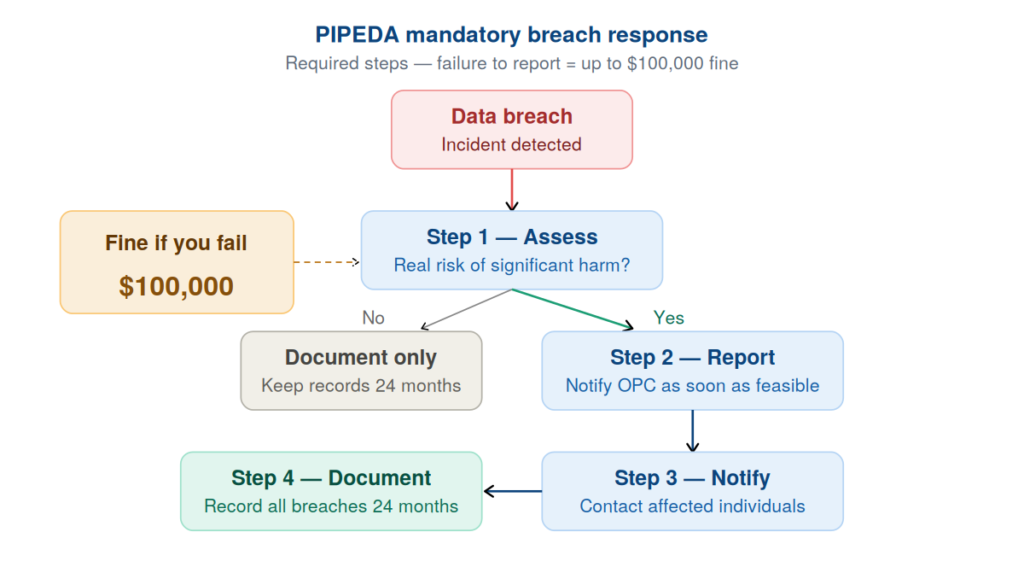
This is the part of PIPEDA that most small business owners are not aware of — and it has real consequences.
Since 2018, PIPEDA requires organizations to:
- Report breaches to the Privacy Commissioner if the breach creates a “real risk of significant harm” to individuals
- Notify affected individuals as soon as feasible after determining the breach occurred
- Keep records of all breaches for 24 months, even those that do not meet the reporting threshold
Failure to report a qualifying breach is an offence under PIPEDA and can result in fines of up to $100,000.

Practical Steps for PIPEDA Compliance
Step 1: Write a privacy policy
Publish a clear, plain-language privacy policy on your website explaining what you collect, why, how you protect it, and how individuals can access or correct their information.
Step 2: Audit what data you collect
List every place you collect personal information — contact forms, email lists, payment systems, client records. For each, confirm you know why you collect it, who can access it, and how long you keep it.
Step 3: Secure your systems
Implement basic cybersecurity controls: strong passwords, multi-factor authentication, encryption for sensitive files, regular software updates, and cloud backup. Our cybersecurity services help Toronto businesses implement these controls properly.
Step 4: Review your third-party tools
Every tool that processes personal information on your behalf — email marketing, CRM, payment processing — must protect that data appropriately. Review their privacy policies and data processing agreements.
Step 5: Create a breach response plan
Know who is responsible for identifying breaches, how to assess severity, how to notify affected individuals, and where to file the report with the OPC. Having a written plan means you will not have to figure this out in the middle of a crisis.
Step 6: Train your team
If you have employees who handle personal information, they need to understand basic privacy principles — not sharing passwords, how to recognize phishing, and who to contact if they suspect a breach.
PIPEDA and Your WordPress Website
If you run a WordPress website, PIPEDA has specific implications:
- Cookies and tracking: If your site uses Google Analytics or Facebook Pixel, you are collecting personal information. Disclose this in your privacy policy.
- Contact forms: Include a brief notice explaining how you use the information submitted.
- Email lists: You need explicit consent and a clear unsubscribe mechanism. Canada’s CASL also governs marketing emails separately.
- Payment processing: Ensure your payment processor is PCI-DSS compliant and you are not storing raw card data on your server.
Choosing software that keeps data on your own server — like our Dyvonix Invoices WordPress plugin — rather than a third-party SaaS platform gives you greater control over your client data under PIPEDA.
Where to Learn More
- Office of the Privacy Commissioner of Canada — plain-language guides for small businesses
- Ontario Consumer Protection — provincial consumer rights
- CASL compliance — for email marketing requirements
How Dyvonix Can Help
Cybersecurity and privacy compliance go hand in hand. Our cybersecurity services for Toronto businesses help you implement the technical controls PIPEDA requires. Our IT consulting team can help you build a privacy compliance framework appropriate for your business size.
Contact us for a free consultation on PIPEDA compliance for your Toronto business.
Summary
PIPEDA applies to almost every Toronto small business that collects personal information. Its ten principles require you to collect only what you need, be transparent about how you use it, protect it appropriately, and give individuals control over their own data. The mandatory breach reporting requirements mean data security is now not just a business risk but a legal obligation. Compliance for a small business does not require a legal team — it requires clear policies, secure systems, and consistent practices.
